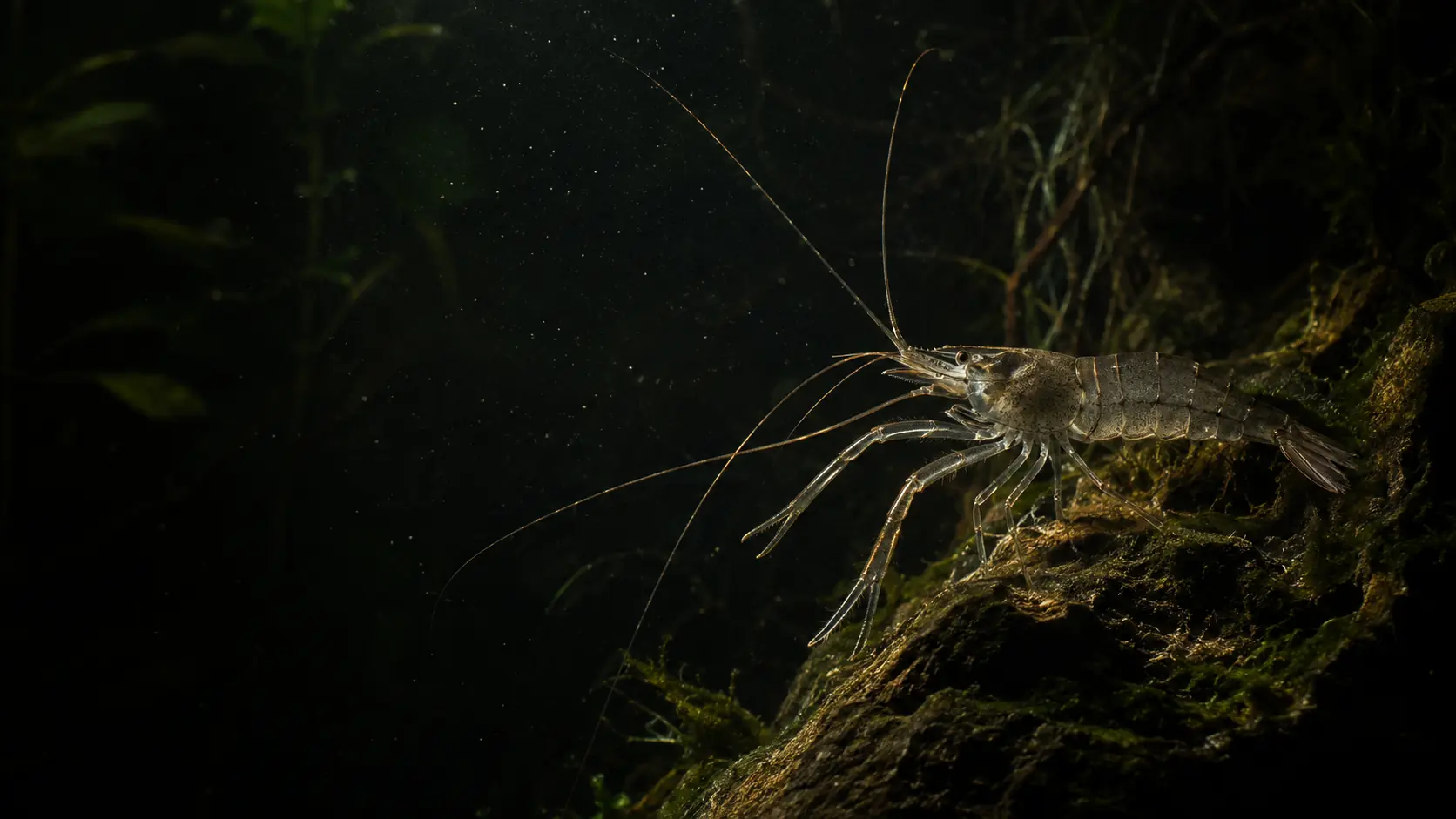
Future programme atlas

Grouped by biology.
Sequenced by capacity.

This atlas records the selected breeding and research collections, their organizing logic, and their readiness. Geography leads where locality shapes the system; life cycle, feeding ecology, and shared culture infrastructure lead where biology creates the stronger design rule.

9
five-species shrimp collections
45
selected shrimp positions
15
selected snail positions
10
locked culture tracks

The organizing method

One hierarchy. Two kinds of status.

The page first answers where the system belongs, then why the animals belong together. Selection state and delivery readiness stay separate so a chosen species is never misread as a scheduled build.

01Environment

Freshwater, brackish, tropical marine, or Eastern Canada / North Atlantic.

02Collection

Lake, region, water platform, life cycle, feeding guild, or support function.

03Species

Named target with provenance and taxonomic uncertainty shown honestly.

04Delivery

Current foundation, planned, researching, deferred, or still open.

Selection state

Does it belong in the portfolio?

  • Portfolio selected — the collection membership is settled.
  • Retained — a valid individual line without a completed collection.
  • Research shortlist — explicit interest, but no build commitment.
  • Category defined — the programme exists; the public roster is still open.

Delivery state

How close is it to a real system?

  • Current foundation — already operating and informing later work.
  • Planned — selected, but prerequisites or scheduling remain.
  • Researching — evidence and design work are active.
  • Deferred — deliberately retained below nearer-term work.

Freshwater shrimp

Water platforms, localities, and specialist biology.

The four current Neocaridina lines establish the neutral-water foundation. Warm/hard and cool/soft lines sit beside them as distinct water platforms. Three Sulawesi collections stay lake-specific, while amphidromous and fan-feeding shrimp are organized around their specialist biology.

Locality-led

Sulawesi lake collections

Each lake supplies its own husbandry, provenance, and founder-locality context.

FW-01Portfolio selected

Sulawesi · Lake Poso

Lake Poso collection

Five shrimp form one lake-specific programme. Water, hardscape, provenance, and sourcing will be designed around the documented conditions and founder localities of Lake Poso.

Organized by
Founder locality
Named entries
5
  1. Pink Boxer shrimpCaridina longidigita
  2. Blue Leg Poso shrimpCaridina caerulea
  3. Poso Glass shrimpCaridina ensifera
  4. White Orchid shrimpCaridina poso
  5. Strawberry / Red Crystal Poso shrimpCaridina marlenae
FW-02Portfolio selected

Sulawesi · Lake Towuti

Lake Towuti collection

Five shrimp form the Lake Towuti programme. Founder locality, water chemistry, and species identity define the collection and its eventual system design.

Organized by
Founder locality
Named entries
5
  1. Harlequin / Towuti Beauty shrimpCaridina woltereckae
  2. Yellow Cheek / Yellow Goldflake shrimpCaridina spinata
  3. Red Orchid shrimpCaridina glaubrechti
  4. Red Line / Red Stripe shrimpCaridina striata
  5. Sun Stripe shrimpCaridina profundicola
FW-03Portfolio selected

Sulawesi · Lake Matano

Lake Matano collection

Five Lake Matano shrimp form a distinct programme. Documented founder locality and species identity are required before animals enter the collection.

Organized by
Founder locality
Named entries
5
  1. Cardinal Sulawesi shrimpCaridina dennerli
  2. Matano Tiger shrimpCaridina holthuisi
  3. Mini Blue shrimpCaridina loehae
  4. Masapi shrimpCaridina masapi
  5. Lake Matano selectionCaridina lanceolata · Trade name not published until verified
Platform-led

Neutral, warm / hard, and cool / soft freshwater

Three water platforms keep current breeding lines and future directions visible in the same freshwater spectrum.

FW-NCurrent foundation

Neutral freshwater · current foundation

Neocaridina colour lines

Four Neocaridina davidi colour lines are already operating as the room's neutral-water breeding foundation. Additional lines can be added individually as the programme grows.

Organized by
Water platform + breeding line
Named entries
4
  1. Bloody MaryNeocaridina davidiCurrent · T-001
  2. Blue DiamondNeocaridina davidiCurrent · T-002
  3. Orange SunkistNeocaridina davidiCurrent · T-003
  4. Yellow GoldenbackNeocaridina davidiCurrent · T-004
FW-04Portfolio selected

South & Southeast Asian trade lines

Warm / hard-water collection

A five-line programme organized around compatible warm, mineral-rich freshwater systems. Trade identities remain qualified until founder provenance supports a firmer name.

Organized by
Water platform + provenance
Named entries
5
  1. Indian Green shrimpCaridina cf. babaulti · Working trade-group identification
  2. Indian Zebra shrimpCaridina cf. babaulti-type · Exact taxon unresolved
  3. Green Rocket shrimpCaridina hodgarti
  4. Rainbow Babaulti shrimpCaridina cf. babaulti ‘Rainbow’ · Trade line
  5. Pinocchio shrimpGracidina gracilirostris
FW-RRetained

Cool / soft freshwater

Cool / soft-water Caridina lines

Three individual Caridina lines define the present cool, soft-water direction. Each remains a standalone future line while the broader collection develops.

Organized by
Production line
Named entries
3
  1. Tangerine TigerCaridina sp. ‘Tangerine Tiger’ · Trade identity to verifyActively researching
  2. Crystal Red / Pure Red LineCaridina cf. logemanni · Working trade-group identificationRetained
  3. Orange-Eye Blue TigerCaridina mariae · Trade lineRetained
Biology-led

Life cycle and feeding guild

Shared life-cycle or feeding requirements define the systems used for these specialist collections.

FW-05Portfolio selected

Freshwater adults · marine larvae

Amphidromous shrimp

Five shrimp united by a cross-salinity life cycle. Their adult systems remain freshwater programmes; the marine larval pipeline is shared infrastructure.

Organized by
Life cycle
Named entries
5
  1. Amano shrimpCaridina multidentata · Existing programme; shown as the technical anchorCurrent foundation
  2. Australian Typus shrimpCaridina typus · Australian-origin foundersNear-term future
  3. Ninja shrimpMarosina serratirostris · Formerly placed in Caridina
  4. White-spotted algae shrimpCaridina leucosticta
  5. Caribbean Rhino shrimpXiphocaris elongata

This collection is organized by life cycle. Fan-feeding shrimp have their own collection because their adult feeding ecology creates a different system-design problem.

FW-06Portfolio selected

Flow-fed specialists

Fan-feeding shrimp

Five specialist filter feeders grouped by the adult system problem: usable current, suspended food, secure perches, refuges, and a realistic larval pathway.

Organized by
Feeding ecology
Named entries
5
  1. Bamboo shrimpAtyopsis moluccensis
  2. Dwarf bamboo shrimpAtyopsis spinipes
  3. Vampire / African giant fan shrimpAtya gabonensis
  4. Brush / Atya shrimpAtya scabra
  5. Green Lace shrimpAtyoida pilipes

Freshwater snails

Five selected neutral-water colonies.

Assassin and white-spotted rabbit snails have Rack 2 assignments. Wizard, Malaysian trumpet, and piano snails are selected colonies awaiting system assignments.

SN-015 selected

Fresh / neutral water

Neutral-water snail colonies

Five dedicated colonies form the selected neutral-water snail programme. Assassin and white-spotted rabbit snails have Rack 2 assignments; the other three await system assignments.

Organized by
Water platform + colony biology
Named entries
5
  1. Assassin snailAnentome cf. helena · Founder identity to verifyPlanned · Rack 2
  2. White-spotted rabbit snailTylomelania sp. · Exact species to verifyPlanned · Rack 2
  3. Wizard snailFilopaludina sp. · Exact species to verifySelected · tank unassigned
  4. Malaysian trumpet snailMelanoides tuberculataSelected · tank unassigned
  5. Piano snailTaia naticoidesSelected · tank unassigned

Rack 2 is reserved for the assassin snail and white-spotted rabbit snail groups. System assignments for the other three colonies will be recorded when decided.

Brackish & anchialine

Five shrimp, with readiness kept honest.

Opae ula and Alpha Opae each have a dedicated, provenance-tracked system concept. Red cave shrimp, Lauan anchialine shrimp, and Palaemon debilis complete the selected research portfolio.

BR-015 selected

Brackish & anchialine

Brackish shrimp programmes

Five shrimp span brackish and anchialine habitats. Opae ula and Alpha Opae have the most developed system concepts; the other three are sourcing- and evidence-led research programmes.

Organized by
Habitat + provenance
Named entries
5
  1. Opae ulaHalocaridina rubra · One future provenance-tracked systemPlanned · lower priority
  2. Alpha OpaeMetabetaeus lohena · One future provenance-tracked systemPlanned · lower priority
  3. Red cave shrimpParhippolyte uveae · Founder locality must set husbandry targetsSelected · sourcing research
  4. Lauan anchialine shrimpAntecaridina lauensis · Lawful source and locality evidence requiredSelected · sourcing research
  5. Feeble shrimp / ʻopae hunaPalaemon debilisSelected · research

The current system concept provides one provenance-tracked system for Opae ula and one for Alpha Opae. The remaining species are selected research programmes without assigned builds.

Marine programmes

Two marine regions. Five shrimp and five snails in each.

Tropical marine and Eastern Canada / North Atlantic are separate regional programmes. Each holds a five-shrimp collection and a five-snail collection built around its own temperature, habitat, and sourcing requirements.

Tropical marine

Ornamental shrimp and functional snails

Ten selected species, with actual regional ranges retained inside the broader tropical operating platform.

MAR-015 selected

Tropical marine

Tropical shrimp

Five ornamental shrimp form the tropical marine programme. Each species keeps its documented regional range within a shared warm-marine operating platform.

Organized by
Region + display ecology
Named entries
5
  1. Skunk cleaner shrimpLysmata amboinensis · Indo-Pacific · two-animal pairing concept
  2. Sexy / anemone shrimpThor amboinensis · Circumtropical complex · 12-animal colony concept
  3. Peppermint shrimpLysmata wurdemanni · Western Atlantic · trade identity requires founder verification
  4. Fire / blood shrimpLysmata debelius · Indo-Pacific
  5. Camel / dancing shrimpRhynchocinetes durbanensis · Indo-Pacific
MAR-025 selected

Tropical marine

Tropical snail colonies

Five tropical marine snails provide grazing, crevice-foraging, sand-sifting, scavenging, and larger benthic roles across the proposed collection.

Organized by
Region + functional diversity
Named entries
5
  1. Stomatella snailStomatella auricula · Indo-Pacific
  2. Histrio trochusTrochus histrio · Indo-Pacific
  3. Florida cerithCerithium atratum · Western Atlantic
  4. Vibex nassariusPhrontis vibex · Western Atlantic
  5. Strawberry conchConomurex luhuanus · Indo-Pacific

The five selections cover grazing, crevice-foraging, sand-sifting, scavenging, and larger benthic roles within the tropical marine platform.

Cold-water regional

Eastern Canada / North Atlantic

Ten selected regional species built around cold, oxygen-rich seawater, lawful sourcing, and locality records.

MAR-035 selected

Eastern Canada / North Atlantic

Cold-water shrimp

Five shrimp define a separate Eastern Canada / Northwest Atlantic programme. The collection requires a genuinely cold, oxygen-rich marine platform and lawful, locality-documented sourcing.

Organized by
Region + biome
Named entries
5
  1. Sand / seven-spined bay shrimpCrangon septemspinosa · Northwest Atlantic
  2. Common grass / marsh shrimpPalaemon vulgaris · Northwest Atlantic
  3. Doll eualid shrimpEualus pusiolus · North Atlantic
  4. Zebra shrimpLebbeus microceros · North Atlantic
  5. Parrot shrimpSpirontocaris spinus · North Atlantic

Selection does not authorize collection or purchase. Canadian regulations, collection locality, seasonal temperature, and source provenance remain release gates.

MAR-045 selected

Eastern Canada / North Atlantic

Cold-water snail colonies

Five regional snails form the cold-marine counterpart to the shrimp collection. Direct development or brooding is favoured where it improves the odds of closing the life cycle in captivity.

Organized by
Region + direct development
Named entries
5
  1. Atlantic dogwhelkNucella lapillus · North Atlantic
  2. Rough periwinkleLittorina saxatilis · North Atlantic
  3. Flat periwinkleLittorina obtusata · North Atlantic
  4. Common whelkBuccinum undatum · North Atlantic
  5. Convex slipper limpetCrepidula convexa · Northwest Atlantic

The regional label does not imply one collection site. Founder locality, thermal history, and legal acquisition route must be recorded for every line.

Live-culture foundation

Ten locked support cultures.

Four phytoplankton and six zooplankton or micro-live-food cultures form the complete starting programme. The leech system remains a separate curiosity and observation tank.

CUL-FW5 locked

Freshwater support

Freshwater culture foundation

Two phytoplankton lines and three zooplankton or micro-live-food lines. Each becomes active only when a viable operating culture is recorded.

Organized by
Authenticated production culture
Named entries
5
  1. ChlorellaChlorella vulgaris · CPCC 90
  2. TetradesmusTetradesmus obliquus · CPCC 10
  3. DaphniaDaphnia magna
  4. MoinaMoina sp. · Identified species/source pending
  5. Freshwater rotiferBrachionus calyciflorus · Target species or another identified suitable freshwater strain
CUL-M5 locked

Marine & larval support

Marine culture foundation

The marine half of the ten-culture programme supports amphidromous larvae, marine research, and future production with a defined set of live-food tools.

Organized by
Larval first foods
Named entries
5
  1. TetraselmisTetraselmis sp. · Target authenticated T. chuiiStarter stock on hand
  2. IsochrysisIsochrysis galbana · CPCC 690
  3. Marine rotiferBrachionus plicatilis species complex · Suitably small morph/strain pending
  4. Brine shrimpArtemia sp. · Species/source pending
  5. Tisbe copepodTisbe biminiensis

Programme governance

A category earns tanks one system at a time.

Selection is not scheduling. A place in a five-species collection records long-range direction. It does not claim that founders are sourced, tanks are available, or a build date exists.

Locality outranks resemblance. Sulawesi collections stay lake-specific, and regional marine work stays attached to real geography and provenance.

Biology can create a shared platform. Amphidromous and fan-feeding shrimp are grouped around repeatable system problems while their regional identities stay attached to each species.

Support systems remain visible. Cultures, larval systems, and companion communities are documented as infrastructure—not counted as animal breeding programmes unless that decision is made.

Every build still has to earn release. Husbandry evidence, legal sourcing, welfare, four-day serviceability, space, and a truthful production or observation purpose all come before acquisition.

Read the evidence standard